Why Retirement Financial Literacy Matters More Than Ever
The New Retirement Reality: Knowledge Is Your Strongest Asset
Retirement used to mean a pension, a gold watch, and a predictable income. But today’s retirees face a very different landscape—rising healthcare costs, complex tax rules, volatile markets, and fewer employer pensions.
In this environment, your most valuable resource isn’t just your savings—it’s your financial literacy.
Financial literacy in retirement means understanding how your money works, how different income sources are taxed, and how to make informed decisions that protect your lifestyle. Without it, even a large nest egg can be vulnerable to costly mistakes.
Why Financial Literacy Matters More Than Ever
1. The Shift from Pension to Personal Responsibility
Today, the responsibility for retirement income has shifted from employers to individuals. With fewer pensions and more self-managed 401(k)s, retirees must make decisions that directly affect their income longevity.
Financial literacy empowers you to choose the right balance between safety and growth, understand annuity and Social Security options, and avoid outliving your money.
2. Inflation and Market Volatility Add Complexity
Markets move quickly, and inflation continues to erode purchasing power. Understanding how to manage market risk—while protecting your income through products like fixed indexed annuities—helps you maintain stability when the economy doesn’t.
3. Healthcare Costs Keep Rising
Healthcare is one of the biggest financial blind spots for retirees. Learning how Medicare works, what supplemental insurance covers, and how to prepare for long-term care costs is critical.
Financially literate retirees plan ahead for these expenses instead of reacting to them—saving thousands of dollars in potential out-of-pocket costs.
4. Taxes Can Take a Bigger Bite Than You Think
Your taxes don’t retire when you do. Understanding how withdrawals from IRAs, 401(k)s, and annuities are taxed—and how strategies like Roth conversions or Qualified Charitable Distributions (QCDs) work—can preserve more of your income each year.
5. Scams and Misinformation Are on the Rise
Retirees are often targeted by scams promising high returns or “risk-free” investments. Strong financial literacy helps you recognize red flags and evaluate opportunities with confidence.
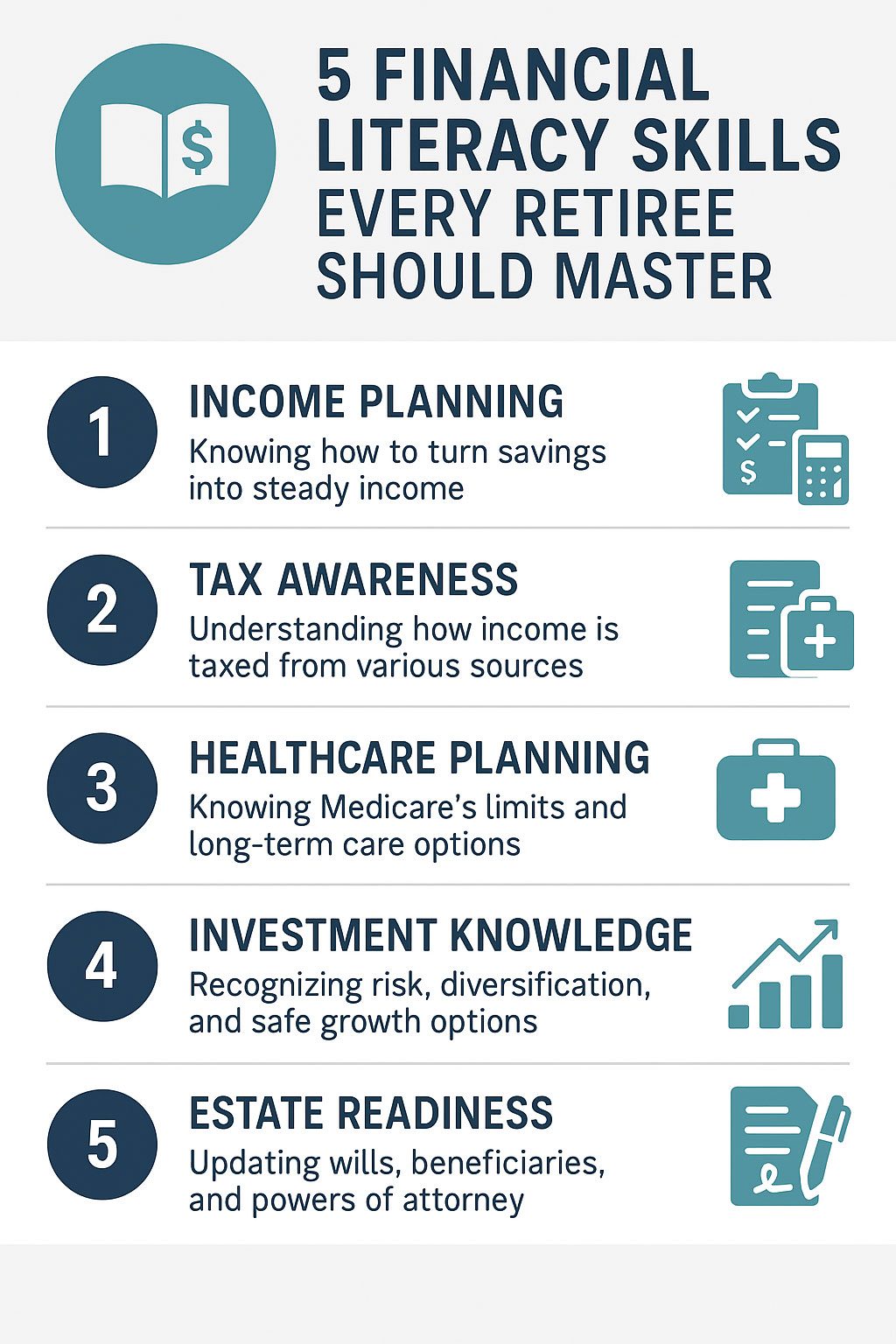
5 Core Financial Literacy Skills for Retirees
| Skill | What It Means | Why It Matters |
|---|---|---|
| Income Planning | Knowing how to turn savings into steady income. | Helps ensure your money lasts as long as you do. |
| Tax Awareness | Understanding how income is taxed from various sources. | Keeps more of your retirement income in your pocket. |
| Healthcare Planning | Knowing Medicare’s limits and long-term care options. | Protects your assets from unexpected medical costs. |
| Investment Knowledge | Recognizing risk, diversification, and safe growth options. | Keeps your portfolio balanced between safety and opportunity. |
| Estate Readiness | Updating wills, beneficiaries, and powers of attorney. | Ensures your wishes are carried out and assets transfer smoothly. |
How to Improve Your Retirement Financial Literacy
1. Start with Education You Can Trust
There’s no shortage of information online—but not all of it is accurate or unbiased. Stick with credible, educational sources such as:
- Government and nonprofit sites (like Social Security, Medicare.gov, or FINRA’s investor education center)
- Reputable financial education platforms that prioritize consumer awareness over sales
- Workshops or webinars offered by independent advisors or educational organizations
SafeMoney.com is designed with this mission—to simplify financial topics and help retirees make informed, confident choices.
2. Ask the Right Questions
Whether you’re working with a financial professional or doing your own research, financial literacy grows faster when you start asking better questions, such as:
- How will this income source be taxed in retirement?
- What happens to my spouse if I pass away first?
- How does this investment perform during market downturns?
- Is my income guaranteed for life—or just a few years?
When you ask, you learn—and that learning builds protection.
3. Understand How Guaranteed Income Fits In
Many retirees don’t realize that creating guaranteed lifetime income is a form of financial literacy. It involves understanding the difference between market risk and income security.
Annuities, Social Security timing, and pension decisions all contribute to your retirement income floor—the guaranteed amount you can count on every month. Once your essential expenses are covered, the rest of your assets can be positioned for growth or legacy planning.
This knowledge gives you the freedom to live without constant financial anxiety.
4. Review Your Plan Annually
Financial literacy is not a one-time achievement—it’s an ongoing habit. Every year, review:
- Your income vs. expenses
- Changes in tax brackets or Medicare premiums
- Investment allocations
- Beneficiary designations
These simple checkups help ensure your plan remains aligned with your current life, not last year’s assumptions.
5. Stay Engaged and Keep Learning
Financial confidence comes from ongoing engagement. Read, attend webinars, follow trusted advisors, and talk to peers who’ve successfully navigated retirement planning.
Even small bits of new knowledge—like understanding how inflation affects income or what a fixed indexed annuity does—can lead to smarter decisions and better results.
The Payoff: Confidence and Control
When you’re financially literate, you move from confusion to control.
You no longer feel unsure about markets, taxes, or healthcare because you understand the “why” behind every decision.
You can:
 Identify gaps before they become problems.
Make informed choices that protect your income.
Feel confident knowing your retirement is built on knowledge, not guesswork.
Financial literacy isn’t about being an expert—it’s about being empowered.
Final Thoughts
Retirement is not the end of financial learning—it’s the beginning of a new chapter where knowledge protects everything you’ve built.
This month, make it your goal to improve one aspect of your financial literacy: learn how an annuity works, explore your tax strategy, or review your healthcare coverage.
Every bit of knowledge adds up to one thing—a safer, more confident retirement.
Written by Brent Meyer, founder of SafeMoney.com. With more than 20 years of experience helping families navigate retirement and legacy planning, Brent is committed to making financial education simple, clear, and trustworthy.
Disclaimer: This article is for educational and informational purposes only and does not constitute financial, legal, or tax advice. Always consult a licensed professional regarding your specific situation. SafeMoney.com is not affiliated with or endorsed by any government agency.
The post Why Retirement Financial Literacy Matters More Than Ever first appeared on SafeMoney.com.
Featured Blogs
- Social Security Survivor Benefits Explained for Couples
- Don't Let Unexpected Retirement Expenses Catch You Off Guard
- Annuities: Embracing the 'Safe Growth' Trend
- Will Social Security Run Out? 2026 Update
- Life Insurance: The Income Bridge Many Couples Miss
- What Happens to Your Income When One of You Is Gone?
- A Paws-On Approach to Understanding Medicare Basics 🐾
- Love Isn’t Just a Feeling—It’s a Retirement Plan
- Understanding Fixed Index Annuities in Today's Market
- Secure Retirement Plans: Annuities & Longevity Strategies
- New Tools, Same Goals: How Retirement Planning Is Evolving 🐾
- Why Market Volatility Hits Retirees Harder Than Workers
- Annuities: Your Forever Treat Bowl in Retirement 🐾
- The Retirement Paycheck: How to Replace Your Salary in Retirement
- Secure Your Retirement with Safe Income Strategies
- 3 Biggest Retirement Income Mistakes After 50
- Why Retirement Income Matters More Than Account Savings
- What Financial Awareness Really Means in Retirement
- Having Savings Isn’t the Same as Having a Plan
- The Secret to Retirement Confidence Is Structure, Not Luck
- What Retirees Should Review Before the New Year
- Preparing Your Retirement Income for the Year Ahead
- 🎾 Fetch Calm, Not Chaos: Keeping Retirement Income Steady
- Missed Medicare Open Enrollment? What Retirees Can Do Now
- Missed Medicare Open Enrollment? What Retirees Can Do Now
- game
- potatoes
- Staying Calm in December Markets: A Bulldog’s Guide to Balance
- Why December Is Ideal for Securing Lifetime Income
- December Medicare Checkup: What to Review Before Jan 1
- 5 Year-End Retirement Blind Spots to Avoid in 2025
- Your December Retirement Checkup Guide
- Black Friday Savings Tips Retirees Can Use This Holiday
- The Retirement Spending Smile Explained
- A Thanksgiving Lesson in Gratitude, Guidance & Guaranteed Income
- Give Thanks, Then Revisit Your Retirement Plan
- blogging
- How to Build Financial Resilience in Uncertain Times
- Smart Charitable Giving Before Year-End
- Understanding RMDs: What Every Retiree Needs to Know Before Age 73
- The Retirement Income Gap: Will Your Money Last?
- The Psychology of Retirement: Aligning Money and Mindset
- The 3-Bucket Plan for Calm Cash Flow
- How to Stress-Test Your Retirement Plan
- Why a Year-End Portfolio Review Could Save Your Retirement
- 4 Retirement Myths That Can Cost You Big Time
- Is Your Medicare Specialist on the Calendar Yet?
- The Retirement Tax Trap: Moves to Make Before Year-End
- How to Use Catch-Up Contributions to Boost Your Retirement
- Why Retirement Financial Literacy Matters More Than Ever
- Why Guaranteed Lifetime Income Is Your Next Big Priority
- Your Year-End Financial Planning Checklist for 2026
- The Hidden Link Between Health Costs and Retirement Security
- The Hidden Link Between Health Costs and Retirement Security
- Tootsie Tuesday Starts Nov. 4—Stay Tuned!
- Keeping Your Financial Plan on Track After Retirement
- Medicare Open Enrollment Starts Today: What You Need to Know
- Protect What You’ve Built: Managing Risk in Retirement
- Protect What You’ve Built: Managing Risk in Retirement
- Turning Savings Into Income: Your Lifetime Paycheck Plan
- The Cost of Waiting: Don’t Delay Your Financial Plan
- How to Calculate Your Retirement Income Gap (Why It Matters)
- October Is National Financial Planning Awareness Month
- The Great Wealth Transfer: Baby Boomers Passing Trillions
- Permanent vs. Term Life Insurance: What’s the Difference?
- One Big Beautiful Bill: What Retirees Need to Know
- One Big Beautiful Bill: What Retirees Need to Know
- The Role of Life Insurance in a Comprehensive Retirement
- IUL Insurance Explained: Pros, Cons, and Misconceptions
- The Role of Life Insurance in Estate Planning
- Tax Advantages of Life Insurance You May Not Know
- Using Life Insurance to Protect Retirement Income
- 5 Life Insurance Myths That Could Cost Your Family
- Life Insurance vs. Annuities: Key Differences Explained
- How Much Life Insurance Do You Really Need?
- Life Insurance Awareness Month: Why It Matters in 2025
- What to Do After You’ve Made Your Will or Trust
- TOD, POD & Beneficiaries: Tools to Avoid Probate
- Passing Down More Than Money: Letters & Legacy Planning
- The Hidden Risks of DIY Wills and How to Avoid Them
- Probate Explained: What It Is and How to Avoid It
- Naming Beneficiaries: The Hidden Danger of Getting It Wrong
- Spotlight Series: Michael Dinich of Your Money Matters, Inc.
- From Retirement Ready to Legacy Ready: What Comes Next?
- What’s Your Retirement Goal—and Are You on Track?
- How Inflation Quietly Erodes Your Retirement Income
- Peace of Mind in Retirement Starts With a Plan
- Avoiding Retirement Surprises Most People Miss
- How Social Security Timing Impacts Retirement Income
- Smart Tax Moves That Boost Retirement Income Longevity
- Spotlight Series Interview with Paul R. Lowe
- Avoiding Market Risks in Retirement: Why It Matters
- How to Create a Retirement Paycheck That Lasts
- Blogg
- deployed the changes to staging
- Testing web blog publication
- blog checking
- test blog not creation issue in sub agents
- Here test
- Cluck Norris
- testing duplicate blog publisher issue
- Reproduce duplicate posting issue
- Testing long running worker
- testing web blog changes (Copy)
- testing with force unlock
- teting
- New capabilities to manage On-Demand Capacity Reservations
- Additional instance types supported for Credential Guard
- AMI deregistration protection
- Added Nitro performance considerations for enhanced networking
- Set IMDSv2 as the account default
- Tag new Linux AMIs created from a snapshot
- Tag new AMIs and snapshots when copying
- EC2 Instance Connect preinstalled on macOS AMIs
- EC2 Instance Connect support for CentOS, macOS, and RHEL
- Amazon Q EC2 instance type selector
- EC2 Free Tier
- Console-to-Code
- Configurable idle connection tracking timeouts
- VolumeStalledIOCheck metric
- PTP hardware clock
- Change instance type of instance enabled for hibernation
- Amazon Data Lifecycle Manager default policies
- Amazon EBS snapshot lock
- Instance topology
- Block public access for snapshots
- Amazon Data Lifecycle Manager pre and post scripts
- AWSDataLifecycleManagerSSMFullAccess AWS managed policy
- Capacity Blocks for ML
- Spot Instance hibernation
- Default settings for block public access for AMIs
- Amazon EC2 Global View
- Disable an AMI
- Attached EBS status checks
- Block public access to AMIs
- EC2 Instance Connect Endpoint
- IMDS Package Analyzer
- EC2 Serial Console bare metal instances
- Launch template quotas
- Capacity Reservation utilization notifications
- Amazon EBS performance updates
- Capacity Reservation groups
- Modify instance metadata options
- In-place macOS operating system updates
- UEFI preferred
- Fault testing on Amazon EBS
- AMI alias in launch templates
- Hibernation support for C6i, I3en, and M6i
- Torn write prevention
- ENA Express
- Recycle Bin retention rule lock
- Copy AMI tags
- AMI size for store and restore
- priceCapacityOptimized allocation strategy for Spot Instances
- price-capacity-optimized allocation strategy for Spot Instances
- Cancel having an AMI shared with your account
- Transfer Elastic IP addresses
- Replace root volume
- Automatically connect instance to database
- AMI quotas
- Configure AMI for IMDSv2
- Initiate Spot Instance interruption
- Verified AMI provider
- Placement groups on AWS Outposts
- Condition keys for Recycle Bin
- Dedicated Hosts on AWS Outposts
- Instance stop protection
- UEFI Secure Boot
- NitroTPM
- AMI state change events
- Describe public keys
- Create key pairs
- Mount Amazon FSx file systems at launch
- New launch instance wizard
- Automatically deprecate public AMIs
- AMI last launched time
- Additional RHEL platforms for Capacity Reservations
- Instance tags in instance metadata
- Capacity Reservations in cluster placement groups
- Recycle Bin for Amazon EBS snapshots
- Amazon EBS Snapshots Archive
- Spot Fleet launch-before-terminate
- EC2 Fleet launch-before-terminate
- Compare timestamps
- Share AMIs with organizations and OUs
- Spot placement score
- Attribute-based instance type selection for Spot Fleet
- Attribute-based instance type selection for EC2 Fleet
- On-Demand Capacity Reservation Fleet
- EC2 Fleet and targeted On-Demand Capacity Reservations
- T3 instances on Dedicated Hosts
- Hibernation support for RHEL, Fedora, and CentOS
- Amazon EC2 Global View
- AMI deprecation support for Amazon Data Lifecycle Manager
- Amazon EC2 key pairs
- CloudWatch metrics for Amazon Data Lifecycle Manager
- CloudTrail data events for EBS direct APIs
- Prefixes for network interfaces
- Event windows
- New Local Zones added
- Deprecate an AMI
- Capacity Reservations on AWS Outposts
- Root volume replacement
- Store and restore an AMI using S3
- EC2 Serial Console
- Boot modes
- Amazon EBS local snapshots on Outposts
- Create a reverse DNS record
- Amazon Data Lifecycle Manager
- Tag AMIs and snapshots on AMI creation
- io2 Block Express preview
- Throughput Optimized HDD and Cold HDD volume sizes
- Mac1 instances
- Use Amazon EventBridge to monitor Spot Fleet events
- Use Amazon EventBridge to monitor EC2 Fleet events
- Delete instant fleets
- Amazon EFS Quick Create
- EC2 instance rebalance recommendation
- Capacity Reservations in Wavelength Zones
- Capacity Rebalancing
- Spot Instance vCPU limits
- Capacity Reservations in Local Zones
- Amazon Data Lifecycle Manager
- Hibernation support for M5a and R5a
- Provisioned IOPS SSD (io2) volumes for Amazon EBS
- Instance metadata provides instance location and placement information
- Wavelength Zones
- Capacity Reservation groups
- Bring your own IPv6 addresses
- Launch instances using a Systems Manager parameter
- Customize scheduled event notifications
- Amazon Linux 2 Kernel Live Patching
- Amazon EBS Multi-Attach
- Stop and start a Spot Instance
- Connect to your instance using Session Manager
- Dedicated Hosts and host resource groups
- Dedicated Host sharing
- Default credit specification at the account level
- Instance type discovery
- Amazon EBS fast snapshot restores
- Instance Metadata Service Version 2
- Queued purchases of Reserved Instances
- Diagnostic interrupt
- Capacity optimized allocation strategy
- On-Demand Capacity Reservation sharing
- EC2 Instance Connect
- Host recovery
- Amazon EBS multi-volume snapshots
- Windows to Linux Replatforming Assistant for Microsoft SQL Server Databases
- Elastic Fabric Adapter
- Bare metal instances for M5, M5d, R5, R5d, and z1d